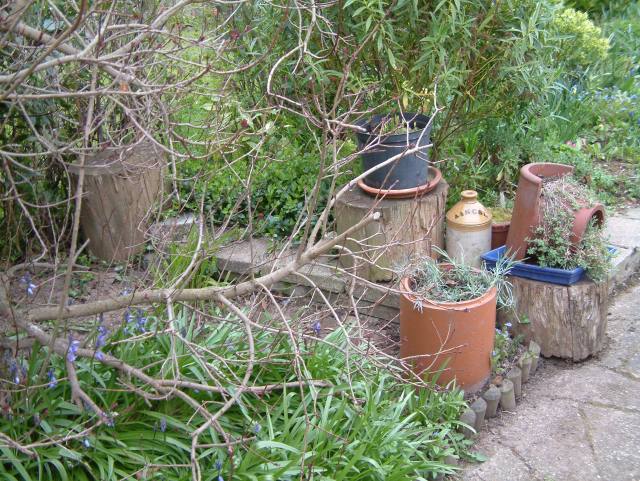
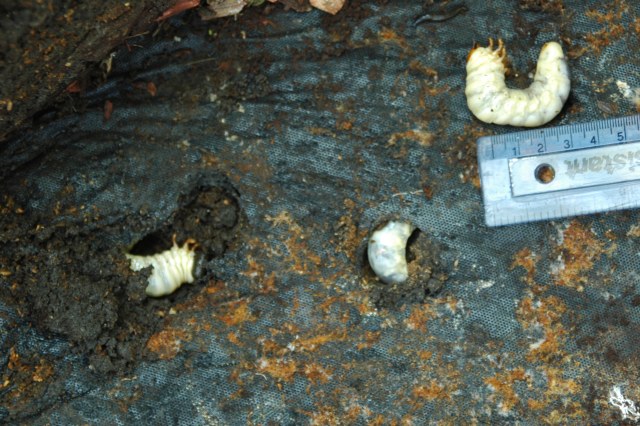
Nest in a builders yard
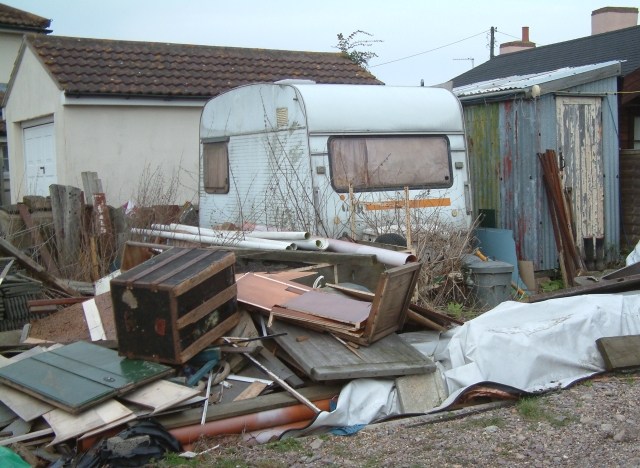
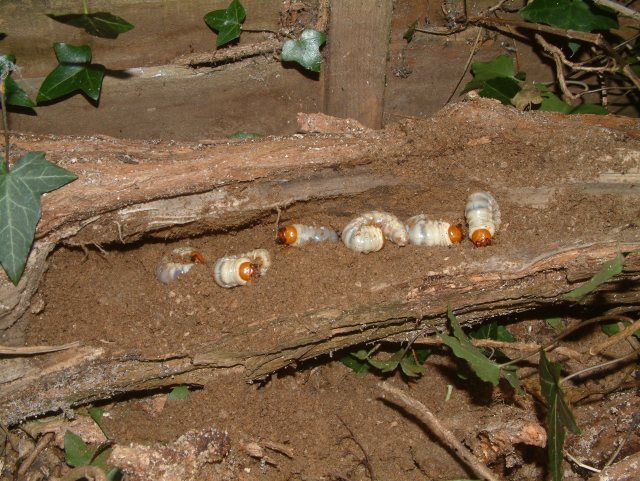
Photo by Maria Fremlin, February 2008.
Stag beetle larvae and one adult were found in a walnut log in the area in front of the caravan. The tree had been cut five years ago.
Return to the top
Nest by a busy roundabout
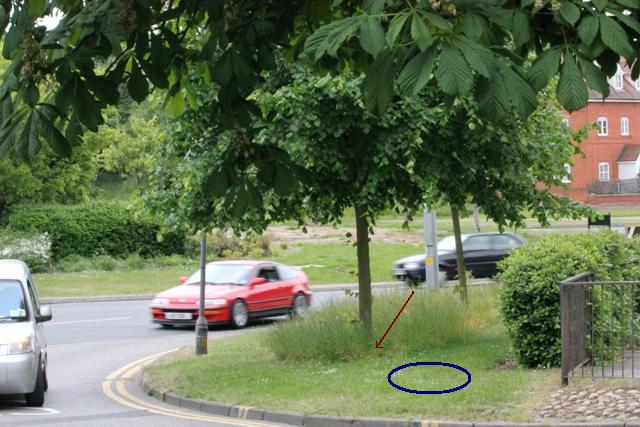
Photo by Maria Fremlin, 9 June 2013.
Stag beetles were seen emerging and fighting in Crouch Street, Colchester, by Theo Tamblyn during the evening of 12 June 2009, 4 males and 3 females. Several days later, about 10 emergence holes were still visible in the area indicated by the blue ellipse.
According to the Borough Council records, the lime trees currently present in this little patch of land in the center of town, were planted in 1972 when the area was redeveloped. Presumably, then a big tree was felled, no records of that though.
It shows a) how long a nest may last b) it really doesn't matter where it is.
STOP PRESS! Several years later, on 5 June 2013, there was a fresh emergence hole in the area, see arrow. Kamilla Skov, a visitor from the Copenhagen Zoo, put her finger in it and caught a huge male, click here to have a look.
Beware! At the beginning of the season, stag beetles have very strong muscles, rather powerful mandibles!
It is absolutely amazing how long this nest has lasted!
Return to the top
Nest on the pavement of an urban street
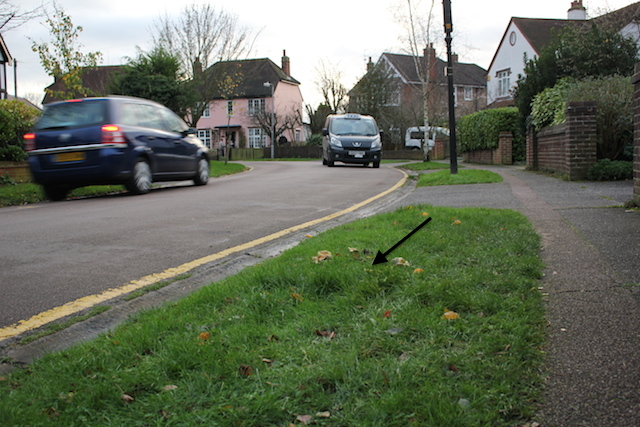
Photo by Maria Fremlin, 15 December 2015.
The arrow is pointing to a cluster of toad stools. Some years ago I spotted some fungi bodies here, possibly sulphur tuft Hypholoma fasciculare which is known to be associated with stag beetle nests. Following enquiries, indeed a cherry tree used to be there some time ago. And in 2009 I found emergence holes and some corpses by this spot; thus confirming my suspicions that a nest might be there. Do keep an eye on fungi in your garden!
Return to the top
This collection of nests shows that the females seem to be very quick at finding places where to lay their eggs. They respond to an active tree management. That is, cutting trees is good for them. But to ensure succession one also needs to plant trees all the time.
When did you last plant a tree in your garden, or anywhere else?
Stag beetles - all they need is love and wood
Last modified: Mon Feb 22 2016
| Main | Model stag beetle nest | Stag beetle conservation |