|
This guide is aimed at gardeners in the United Kingdom, and it doesn't cover weevil larvae which have no legs.
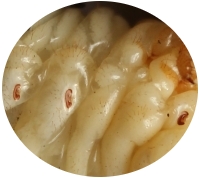
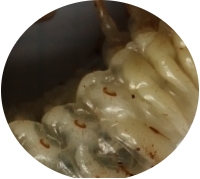
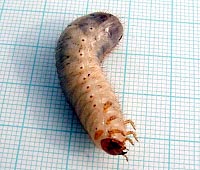
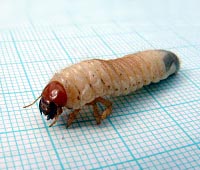
Larvae photos are on millimetric paper, 1 mm smallest division. With some browsers when you move your cursor over the photos, you will be able to get more information about the pictures. In particular the larval head capsule width (HCW).
|
| Stag beetle
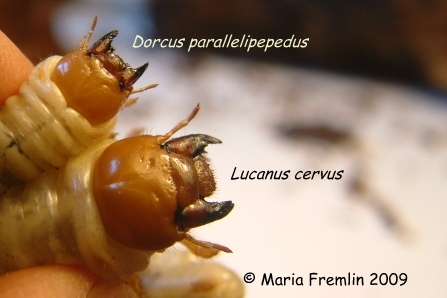
Lucanus cervus |
Lesser stag beetle
Dorcus parallelipipedus |
Rose chafer
Cetonia aurata |
Cockchafer or Summer chafer
Amphimallon solstitialis [1] |
|
| Larva | ![]() |
|
![]() |
![]() |
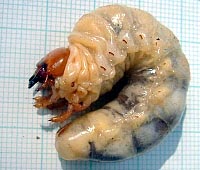
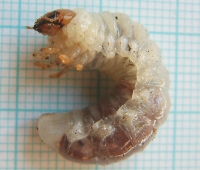
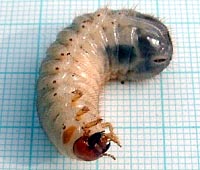
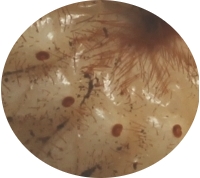
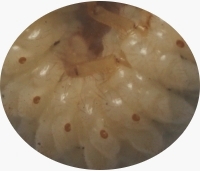
| Description | C-shaped. Very pale cream coloured soft transparent body, very plump almost cylindrical with segments not raised in three folds, nice to the touch. It has six stout orange legs, and an orange coloured head with very sharp brown straight pincers. The longitudinal anal opening is surrounded by 2 characteristic lobes. For more click here. | C-shaped. Almost identical to the stag beetle larva, the head is somewhat paler, it doesn't reach the same size as the stag beetles. Pale gut contents, as they spend their time feeding only in the wood, and unlike stag beetles have no contact with the soil. To really distinguish them you will have to look at their posterior ends, which are subtly different. | C-shaped, very tightly curved sometimes. It has a much less distinct head, with curved pincers, very short legs, and its body is very wrinkly and firm to the touch, covered with very fine pink hair. Anal opening transverse. It looks a bit like a concertina, so it is the easiest larva to identify correctly. Click on the picture for a better view of the larva. |
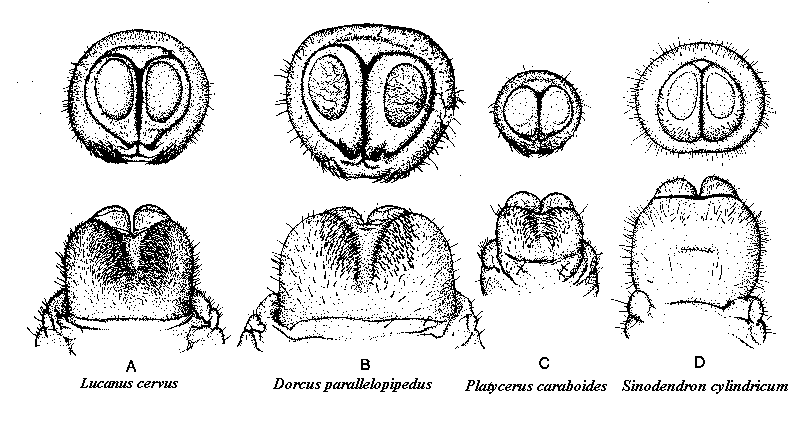
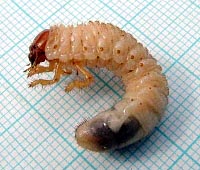
C-shaped. Creamy coloured hairy body darker and thinner than the stag beetle, with folded segments, longer legs and not such a distinct chestnut coloured head, with curved pincers. Anal opening transverse. Compare meikever, cockchafer, with vliegend hert, stag beetle, in this photo by Bert van Geel. |
| Size | When fully grown, up to 8 cm long and nearly 2 cm thick. See here for larvae at different stages of development. It is the biggest larva to be found in a garden in the U.K. | Doesn't reach the same size as the stag beetle larva. Around 6.5 cm. For instance, the larva shown is fully grown, compare its size with the one on the left, also in the last instar. | Around 3.5 cm when fully grown. | Around 5 cm when fully grown. |
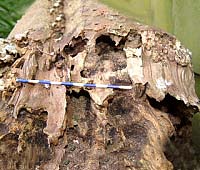
| Habitat | Tree stumps, old trees and shrubs, rotting fence posts, decorative logs, compost heaps and leaf-mould piles. Mostly under the ground in natural situations. However it can be found feeding above the ground in log piles, etc. Note the galleries that the larvae have made. Scale is in 1 cm divisions. |
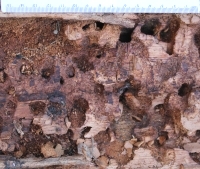
Shares the habitat with the stag beetle but it prefers to feed above the ground. It is a kind of upstairs-downstairs arrangement. |
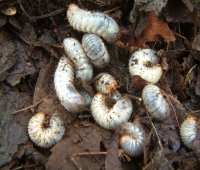
Shares the habitat with the stag beetle, and it is very frequently found in compost, leaf-mould and manure heaps in great numbers. They are the equivalent of earth worms and help break things down so they are very beneficial. Gardeners quite often believe that they are stag beetle's larvae, which is no problem as both are very beneficial decomposers. Click on the picture for another clutch. |
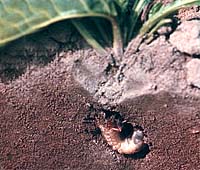
Feeds on fresh roots, does great damage; usually associated with lawns. They are not to be found in decaying wood or the compost heap. |
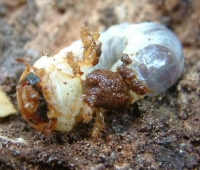
| Behaviour |
Curls up in a C or rolls up on its back as if being tickled. Also it often defecates as a reaction to being handled. Video |
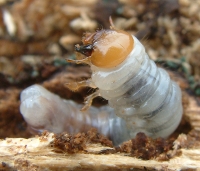
The same as for the stag beetle. The defecation is a defensive reflex reaction. Compare frass colour with the one on the left. Video |
If placed on a flat surface will crawl on its back! In the U.S.A. larvae with similar behaviour are called crawly-backs. Video |
If placed on a flat surface it will 'run' dragging its tail end behind. |
| Pupation |
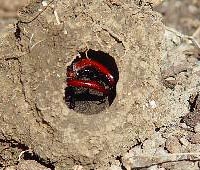
Below the surface in a soil compacted cocoon, the size of an orange. |
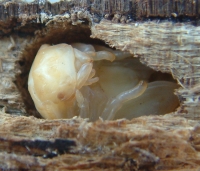
Above the ground in the wood where it has been feeding. Click for a better view. |
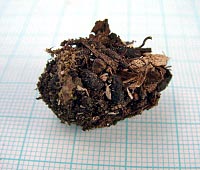
In the soil/compost in a soil compacted cocoon, the size of a blackbird's egg. |
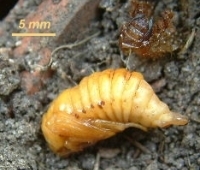
In the soil, near where it has been feeding. This is the pupa from the larva shown at the top. Notice its exuvia, top right corner. |
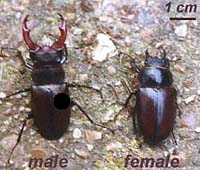
| Imago |
Click on the picture to view more photos. |
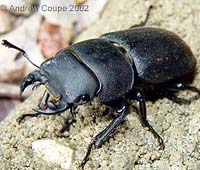
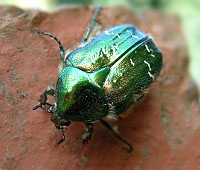
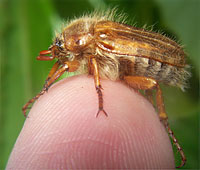
Click on the picture to view another likely culprit, the true cockchafer. [1] |
| Action | Stag beetle larvae will not damage your trees, crops or flowers.
Just leave them where they are as they don't seem to respond well to being moved. |
The same as for the stag beetle larvae. | Just leave them, first they work on your compost, then they look absolutely delightful on your flowers, which they will not damage. | Pest. However if you aren't absolutely sure of their identification, take them to your nearest wild life center/ natural history museum. |
| [1] - The larva shown at the top
right was picked up in my allotment where summer chafers, or June bugs, Amphimallon
solstitialis are often seen flying during summer evenings from late June; they emerge around the summer solstice, hence their common and scientific name. Among the allotmenteers they are known as cockchafer; elsewhere they can also be called chafer grubs or rookworms. However there is some confusion here as regards these common names, the true cockchafer, or May bug, is supposed to be Melolontha melolontha, which I've never seen in this area. It really doesn't matter as either of these chafer grubs feed on fresh roots.
But it does show how misleading common names can be. For instance, billywitch is another popular name attributed to at least three beetles. |
| The results of the National Stag Beetle Survey 2002 showed that 70% of the stag beetle sightings come from gardens, let's make them a safe haven for stag beetles. |
If you find any stag beetle larvae, please, get in touch with me. Also, I should be very grateful if you could spare a few minutes to participate in the Stag beetle larval incidents in private gardens survey. |
|
LINKS: Larven in soorten en maten, by Smit, J.T. 2005 - A very interesting article comparing larvae of stag beetles (vliegend hert) Lucanus cervus, rhinoceros beetles (neushoornkever) Oryctes nasicornis, and cockchafers (meikever) Melolontha melolontha larvae. Rose Chafer Survey - Please enter your records even if they are null, as it would be very interesting to get an update view on the distribution of this beetle. How to sex Cetonid larvae - Interesting photos of the Herold organ - terminal ampula - by Serge Mallet. |
|
Acknowledgments
|
Last modified: Tue Sep 29 11:13:48 GMT 2009
| Main | Stag beetle larvae | Helpline | Grubs in my compost | Larva quiz |