First of all: Can stag beetles eat?
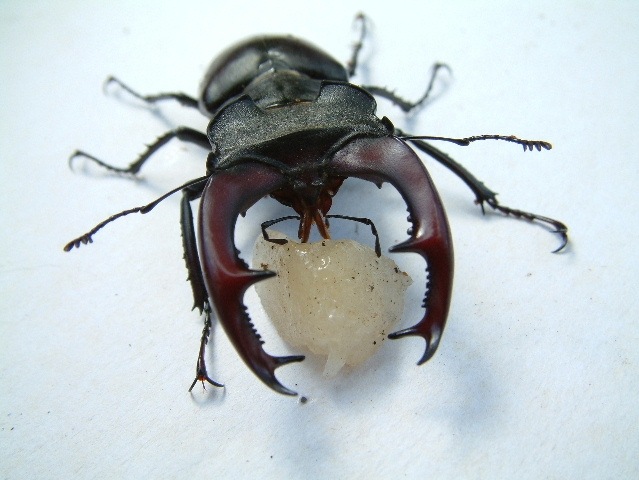
Yes! But they can't eat any solids. Instead, sometimes they might have a drink. Indeed, one of my early experiences is that they were rather partial to sweet juicy fruits. As you can see below the beetle is very interested in on a juicy melon. He is tasting it with his palps, the long dark brown things touching the melon.
Male stag beetle enjoying a ripe juicy melon. Photo by Maria Fremlin, June 2003.
Then, how do they drink?
Look again at the above photo.
Can you see two pale brown “feathery bits” just about touching the melon?
Well, the beetle laps up the juice by plunging them, rhythmically, into the food.
This behaviour can be seen clearly on this video of a stag beetle feeding on a plum.
When drinking directly from a liquid, they sweep over it, also rhythmically. Watch this video of a female stag beetle drinking maple syrup.
By the way, the scientific name of those “feathery bits” is galeae. If you want to know a bit more about their very interesting mouthparts, please click here.
What do they drink in the wild?
1. Stag beetles, as well as other insects, are attracted to sap runs which are very sweet and ferment easily. See this page: Mate-guarding behaviour in the stag beetle Lucanus cervus.
However, in the UK there are no reports of such observations. If you ever see that, do not hesitate in getting in touch with me.
2. Stag beetles may also drink from soft fallen fruit, for example cherries. Indeed one of their old English names, cherry-eaters, attests to that. See below a photo of a male stag beetle enjoying the juices of an overripe cherry (Prunus avium).
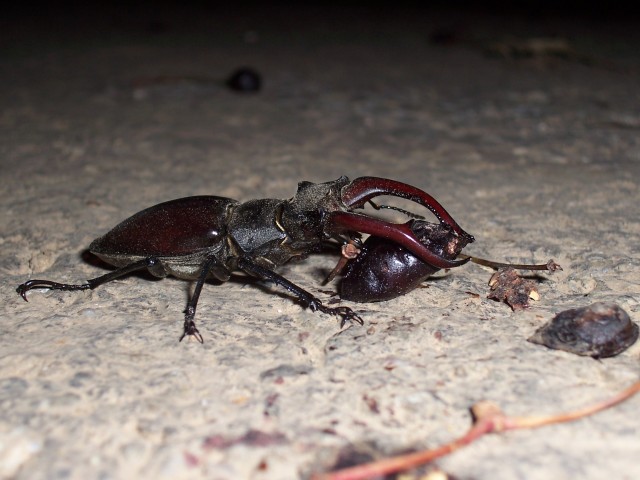
Male stag beetle holding on to a cherry in a sunken lane (holle weg in Dutch), near Etzenrade, Limburg, The Netherlands. Photo by John T. Smit, 19 July 2005.
3. They may be tempted by other liquids, some of them very hard to believe.
For example, once I came across a female stag beetle at the end of the season drinking the moisture from a fox's poo! See below.
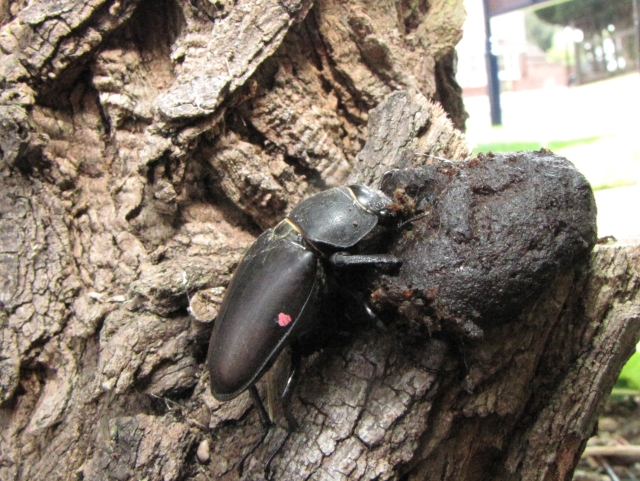
Female stag beetle feeding at the end of the season. Photo by Maria Fremlin, 28 July 2011.
Click on the picture to see a movie of how slowly she moved!
4. The other example of strange drinking behaviour was when some male stag beetles were discovered fighting with an empty snail shell. At the end one of them drank up the liquid inside it. For more click here.
How can they survive without eating?
Stag beetles have enough fat reserves to keep them going during the short time that they spend above the ground; these reserves have been accumulated by their larvae during the last stage of their long life underground.
Further reading:
Fremlin, M. & Hendriks, P. (2011) Sugaring for stag beetles - different feeding strategies of Lucanus cervus and Dorcus parallelipipedus. Bulletin of the Amateur Entomologists' Society, 70 (495): 57-67. [PDF]
Fremlin, M. & Hendriks, P. (2013) Lesser Stag Beetles Dorcus parallelipipedus (Coleoptera: Lucanidae) longevity - at least three years. Bulletin of the Amateur Entomologists' Society, 72 (507): 48-56. [PDF]
Hawes, C. (2004) Stag Beetles at Sap. White Admiral, 57.
Hongo, Y. (2005) Diurnal activity of the Japanese stag beetle Prosopocoilus dissimilis okinawanus Nomura (Coleoptera, Lucanidae). Elytra, 33: 245-257.
Jansson, N. (2011) Attraction of stag beetles with artificial sap in Sweden. Bulletin of the Amateur Entomologists' Society, 70 (495): 51-56.
Krenn, H.W., Pernstich A., Messner T., Hannappel U., Paulus H.F. (2002) Kirschen als Nahrung des männlichen Hirschkäfers, Lucanus cervus (Linnaeus 1758) (Lucanidae: Coleoptera). Entomologische Zeitschrift 112/6: 165-170. [PDF]
Nash, D. (2003) Red Admiral Butterflies at Sap. White Admiral, 56.
Ratcliffe, B.C. (1970) Collecting slime flux feeding Coleoptera in Japan. Entomological News 81: 255-256.
Last modified: Sun Feb 14 2016