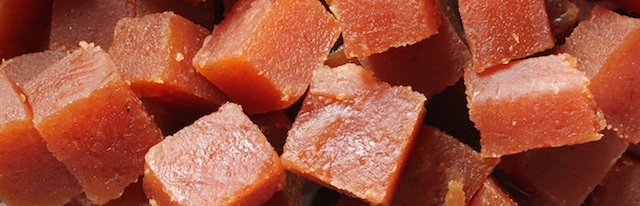
These delightful sweets are made a bit like jam except that it is a very thick one, a quince cheese in fact. When set, it is poured on trays and left to dry; then cut into small squares.
They were inspired by the Marmelada Branca de Odivelas a very old recipe from my boarding school, Instituto de Odivelas. But I make them in a much simpler way and with half the sugar!
The nearest alternative to these are boxes of quince cheese imported from France, Spain or Portugal. The reddish quince cheese sold, respectively, under the name of “pâté de coing”, “membrillo” or “marmelada”. Some specialist shops sell this thick paste by the cheese counter wrongly named as “quince jelly”. In any case, it goes wonderfully well with some cheeses and is becoming increasingly popular.
Wash the quinces, either freshly picked or from the freezer, remove any rotten bits and rub away the down from the skin. Note: there is no need to peel the quinces, at all.
Put the washed quinces in a pan and barely cover them with cold water. From now on regulate the heat so that the water comes slowly to the boil and the fruit barely simmers. Depending on the heat, I do this for 1 or 2 hours or until they start showing signs of softening. With my quinces, Meech's Prolific, I stop when the skins start splitting or else they quickly disintegrate, which complicates things a bit. So whatever you do watch them while they very, very gently simmer away and remove them from the heat when softened but still whole.
At this stage, I leave them to cool in a draining rack until next day. Save the water for jelly making, if you can.
When cool, quarter and remove the cores; this can now be done almost effortlessly compared with the raw fruit. The cores could join the cooking water for jelly making; just boil them for a while in it and then strain for basic jelly making.
Weigh the quince flesh, blend or mash them and put them in a good preserving pan with an equal amount of sugar and the heat to maximum.
Now comes the tricky bit. You must stir this mixture, scrapping the bottom of the pan all the time otherwise it will burn - best done with a long handled wooden spoon and your hand wrapped in cloth. It will bubble and spit just like those volcanic mud ponds in the Yellowstone National Park.
The jam is set when the paste leaves the sides of the pan. It takes about 10 minutes in very high heat with me.
Pour into flat trays lined with a good non-stick cooking membrane and leave in the airing cupboard until the top is very dry to the touch.
Turn it regularly to allow the bottom to dry up as well.
Do not use grease proof paper for lining the trays as it is difficult to remove at the end; the best performance, so far, goes to cook-in bags. Just split a bag open and line the tray with it. They can be re-used many times.
I leave my trays to dry for well over one month and turn them regularly to allow for the bottom to dry. When thoroughly dry both sides, cut into little squares and store between grease proof paper in airtight containers.
They are absolutely lovely with cheese and make a very popular present Christmas present.